

Tesla Roadster ‘Flying Car’ Unveiled by Elon Musk in Dramatic SpaceX Demo
Turns out the future does have flying cars
— Elon Musk (@elonmusk) October 16, 2026
♪
Listen to this article
Hear this story, then continue listening to NIO Radio.
Ready to play.
Article audio is not available in this browser.
Tesla has unveiled a new version of its long-awaited Roadster, with Elon Musk demonstrating technology that allows the electric supercar to briefly become airborne.
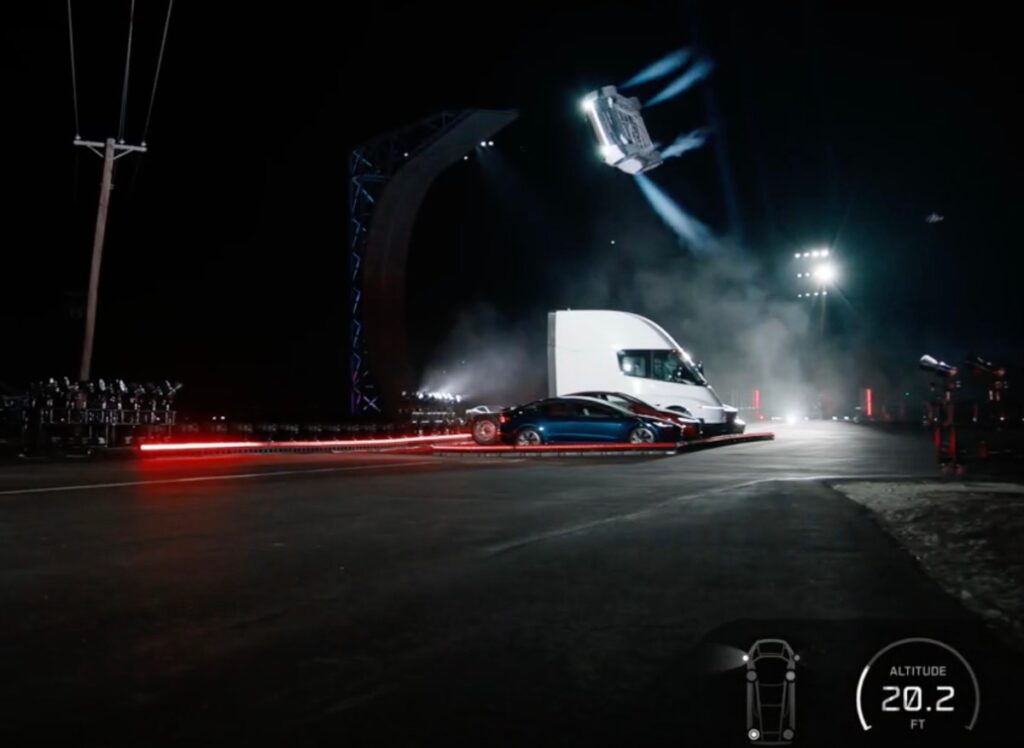
The Tesla Roadster flying car demonstration used SpaceX-developed cold-gas thrusters to launch the vehicle into the air, rotate it and bring it back down.
Tesla says the new Roadster can accelerate from 0–60mph in under one second, exceed 230mph and travel more than 300 miles on a charge.
However, the most extreme flying version will not be approved for normal public road use.
Production is currently targeted for 2028.
Tesla Roadster Flying Car Makes Dramatic Debut
Elon Musk has unveiled Tesla’s long-delayed next-generation Roadster, and this time it did something few expected to see from a production car: it left the ground.
The new Tesla Roadster flying car was demonstrated at a SpaceX facility in Texas on Thursday, 15 October.
During the event, the vehicle used rocket-style thrusters developed with SpaceX to perform a series of unusual manoeuvres.
The Roadster drove upside down using a suction system, turned in mid-air and later jumped over several other Tesla vehicles.
According to Reuters, the vehicle landed using built-in thrusters after completing the demonstration.
[Insert Link: Reuters Tesla Roadster report]
How Does the Tesla Roadster Fly?
Despite the headlines, the Roadster does not fly like an aeroplane or helicopter.
Instead, Tesla is using extremely high-pressure compressed air and cold-gas thrusters.
These thrusters can create enough force to launch the vehicle off the ground and control its movement while airborne.
The system also allows the vehicle to rotate during short aerial manoeuvres.
It is effectively using technology inspired by spacecraft rather than traditional automotive engineering.
Musk said the system gives the Roadster rocket-like capabilities.
New Tesla Roadster Performance Figures
Tesla says the next-generation Roadster will offer extraordinary performance.
Key figures announced during the demonstration include:
- 0–60mph in less than one second
- Top speed of more than 230mph
- More than 300 miles of electric range
- SpaceX-developed thruster technology
- Active aerodynamics and suction technology
- Production currently planned for 2028
Tesla engineers demonstrated a 0–60mph time of around 0.81 seconds during the event.
However, final production specifications could change before customer vehicles are built.
[Insert Link: Official Tesla Roadster page]
Three Different Roadster Versions Planned
Reports following the unveiling indicate Tesla is planning three different versions of the Roadster.
Roadster Performance
The Performance model is designed as the more conventional road-going version.
It is expected to seat two people and use active aerodynamics alongside Tesla’s suction technology.
Tesla is targeting a 0–60mph time below 1.6 seconds.
Roadster Thrust
The Thrust version adds rear-mounted cold-gas thrusters.
Tesla says this could reduce the 0–60mph time to under one second.
This model is expected to be produced in limited numbers.
Roadster Rocket
The Rocket version is where things become considerably more extreme.
It is expected to be a single-seat vehicle equipped with thrusters positioned around the car.
Those thrusters provide vertical, lateral and rotational movement.
This is the version designed for the short airborne manoeuvres shown during Tesla’s demonstration.
However, it is not expected to be approved for normal public road use.
Tesla Roadster Has Been Nearly a Decade in Development
The new Roadster has had one of the longest development periods of any Tesla vehicle.
Tesla first revealed the second-generation Roadster in November 2017.
At the time, the company said production could begin in 2020.
That deadline passed, followed by several further delays.
The latest target is now 2028, meaning customers could be waiting more than a decade from the original announcement to production.
The Roadster shown this week also differs considerably from the vehicle originally presented in 2017.
How Much Will the Tesla Roadster Cost?
Tesla did not announce a final purchase price during the latest presentation.
Reuters reported that Tesla’s reservation system showed a $50,000 deposit for the Performance version.
A Thrust version reportedly requires a $250,000 deposit.
The Rocket version is described as invite-only.
Tesla originally suggested a starting price of around $200,000 when the second-generation Roadster was first revealed, but there is currently no confirmed final price for the new models.
Is It Really a Flying Car?
Calling the Roadster a “flying car” needs some qualification.
Tesla has demonstrated that the vehicle can become airborne and manoeuvre while off the ground.
However, the demonstration involved short-distance jumps and controlled aerial movements rather than sustained conventional flight.
That makes the Roadster considerably different from proposed flying taxis and other vehicles designed to travel significant distances through the air.
Nevertheless, fitting an electric road vehicle with a functioning rocket-style propulsion system represents an unusual engineering achievement.
Musk Admits Safety Is Not the Main Priority
Musk also acknowledged that the most extreme Roadster configuration is focused more on performance and spectacle than everyday practicality.
The flying demonstration was conducted in controlled conditions, while the vehicle’s most extreme configuration is not intended for ordinary public-road use.
Significant regulatory and safety hurdles would also need to be addressed before similar technology could become widely available.
When Will the New Tesla Roadster Go on Sale?
Tesla currently says Roadster production is expected to begin in 2028.
However, that date should be treated as a target rather than a guaranteed launch date.
The Roadster was originally expected to enter production in 2020 and has since faced several delays.
For now, the flying Tesla remains one of Tesla and SpaceX’s most unusual engineering demonstrations.
Whether drivers will eventually be able to buy something close to the prototype shown in Texas remains to be seen.
What Do You Think?
Would you trust a Tesla capable of launching itself into the air, or should cars stay firmly on the ground?
Let us know your thoughts and follow Northern Ireland Online for more technology, motoring and breaking news.
Local guide
Explore more across Northern Ireland
More News
Tesla Roadster ‘Flying Car’ Unveiled by Elon Musk in Dramatic SpaceX Demo
16 October 2026
No Comments
Read More »
HGV Seized in Ballymena After Police Discover Cloned Number Plates
15 October 2026
No Comments
Read More »

Where To Eat
Local guide