

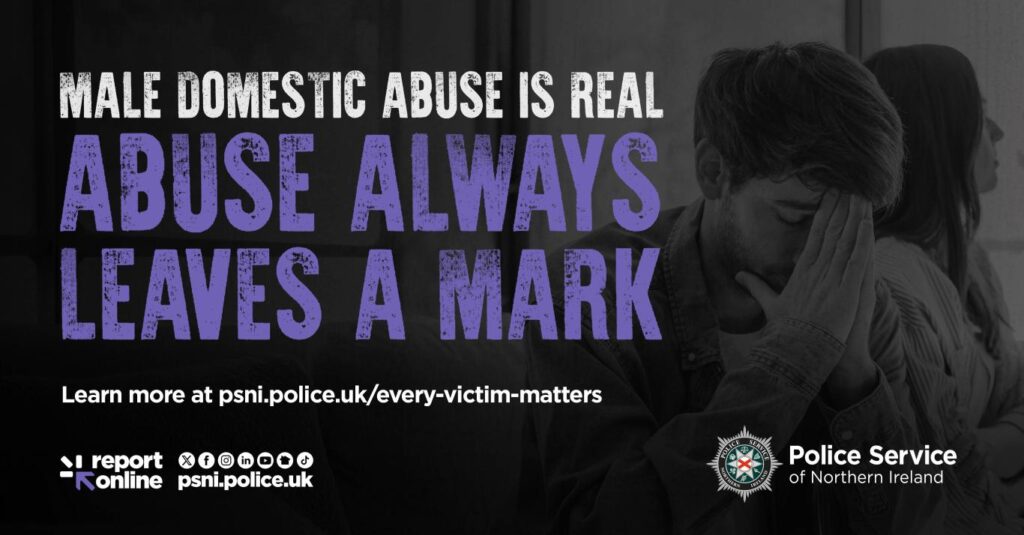
PSNI launches ‘Every Victim Matters’ campaign highlighting male domestic abuse victims
♪
Listen to this article
Hear this story, then continue listening to NIO Radio.
Ready to play.
Article audio is not available in this browser.
The Police Service of Northern Ireland has launched its new Every Victim Matters campaign to raise awareness of domestic abuse against men.
PSNI figures show 5,817 domestic abuse crimes involving male victims were recorded across Northern Ireland between April 2025 and March 2026.
Men accounted for 32% of all recorded domestic abuse crime victims during that period.
The campaign, launched in partnership with the Men’s Advisory Project, aims to challenge stigma and encourage men experiencing abuse to seek support.
Find out more about Every Victim Matters
The PSNI Every Victim Matters campaign has been launched across Northern Ireland to highlight the reality of domestic abuse against men and encourage victims to seek help.
The Police Service of Northern Ireland is running the campaign in partnership with the Men’s Advisory Project.
Titled Every Victim Matters, the campaign aims to challenge misconceptions about male domestic abuse and highlight the different forms abuse can take.
These can include:
- Coercive control
- Emotional and psychological abuse
- Financial control
- Intimidation
- Isolation from friends and family
- Controlling behaviour
- Physical abuse
Police say domestic abuse can affect anyone, regardless of gender, age or background.
More information about the campaign is available on the PSNI Every Victim Matters website.
More than 5,800 domestic abuse crimes recorded against men
Figures released alongside the Every Victim Matters campaign show the scale of male domestic abuse in Northern Ireland.
Between April 2025 and March 2026, the PSNI recorded 5,817 domestic abuse crimes involving male victims.
Male victims accounted for 32% of all victims of domestic abuse crimes recorded during that period.
According to police, those crimes had a sanction outcome rate of approximately 19%.
Male domestic abuse: key figures
5,817 domestic abuse crimes involving male victims recorded from April 2025 to March 2026
32% of recorded domestic abuse crime victims during the period were male
19% approximate sanction outcome rate for those recorded crimes
PSNI: ‘Abuse is abuse’
Speaking at the campaign launch, Detective Superintendent Kerry Brennan said officers regularly encounter men who have been made to feel that their experiences do not deserve to be heard.
She said:
“As officers, our job is to protect without prejudice. Abuse is abuse. It’s not a lesser crime because the victim is male, and it’s not something to be minimised or joked about.”
Detective Superintendent Brennan said every victim deserves dignity, support and the reassurance that the law is there to protect them.
She also encouraged men experiencing domestic abuse to come forward.
“Your voice matters just as much as anyone else’s. We will listen, and we will act.”
Information about reporting concerns to police can be found on the PSNI website.
Campaign highlights coercive control and emotional abuse
The PSNI Every Victim Matters campaign also focuses on abuse that may not involve physical violence.
Coercive control can involve patterns of threatening, intimidating, humiliating or controlling behaviour.
Emotional abuse can also leave victims frightened, isolated or feeling unable to leave a relationship.
Police want men to recognise that these behaviours can constitute domestic abuse and that support is available.
Men’s Advisory Project supports more than 1,000 men and boys each year
The Men’s Advisory Project supports more than 1,000 men and boys affected by domestic abuse across Northern Ireland each year.
Rhonda Lusty, CEO of the organisation, welcomed the PSNI campaign and its clear message that male domestic abuse is real and serious.
She said many men who approach the organisation have lived with abuse, coercive control, fear and isolation for a long time before telling anyone what is happening.
Ms Lusty said:
“Domestic abuse can happen to any man, at any age and from any background.”
She added that domestic abuse can happen within intimate relationships or families and does not always involve physical violence.
Her message to victims was:
“What is happening to you matters. You can speak to the police and you can speak to us.”
Anyone seeking specialist information or support can visit the Men’s Advisory Project website.
Justice Minister backs Every Victim Matters campaign
Justice Minister Naomi Long has funded the campaign and publicly backed its message.
She said:
“The reality is that anyone can become a victim of domestic abuse and that’s why this campaign is so important.”
The Justice Minister said men affected by intimate partner abuse should never feel ashamed or unable to seek help.
She added:
“Support is available; speaking up is the first step in the road to recovery.”
Public urged to recognise signs of domestic abuse
The campaign also encourages friends, relatives and colleagues to look out for signs that someone they know may be experiencing abuse.
Possible warning signs can include:
- Becoming increasingly isolated
- Appearing frightened of a partner or family member
- Having finances or movements controlled
- Regularly being belittled or humiliated
- Receiving excessive calls or messages checking their whereabouts
- Making excuses for a partner’s behaviour
- Significant changes in confidence or personality
People are encouraged to offer support without judgement and help victims access professional services.
Where to get help
Men experiencing domestic abuse can find further information through the following organisations:
Male domestic abuse: support is available
If you are experiencing domestic abuse, information and specialist support are available.
Find out more
The public is being encouraged to recognise the signs of domestic abuse and reach out if they believe someone they know may need help.
For more information, visit:
Local guide
Explore more across Northern Ireland
More News

£8m Home Bargains Store Approved for Antrim, Creating 95 Jobs
23 October 2026
No Comments
Read More »

Woman assaulted with bat after masked men enter Newtownabbey home
23 October 2026
No Comments
Read More »

Where To Eat
Local guide