
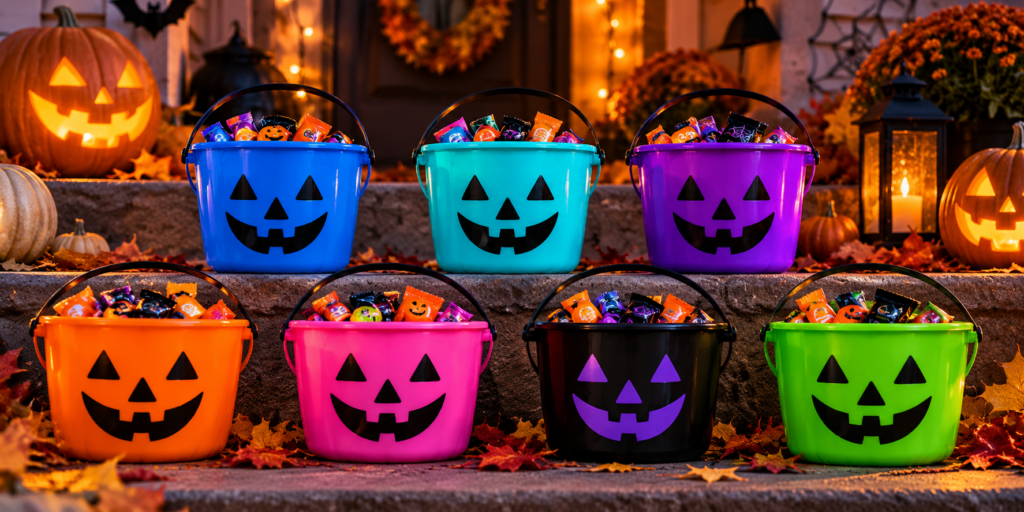
Halloween Bucket Colours Explained: What Do Blue, Teal, Purple and Other Colours Mean?
As Halloween approaches, colourful trick-or-treat buckets are appearing across social media, with claims that each colour carries a special meaning. But where did the idea originate, and how much of it is actually true?
For generations, Halloween has meant dressing up, carving pumpkins and heading around the neighbourhood with a bucket ready to collect sweets.
However, in recent years, some families have started using different coloured pumpkins and trick-or-treat buckets to raise awareness of disabilities, medical conditions and individual needs.
You may have seen a popular image circulating on Facebook suggesting that blue represents autism, teal represents food allergies, purple represents epilepsy, and other colours have meanings of their own.
The message behind the image is a positive one: Halloween should be enjoyable and welcoming for everyone.
But there is an important distinction. Some colours are connected to established awareness campaigns, while others are informal social media interpretations rather than universally recognised symbols.
Here is where the different Halloween colours came from, what they represent and what families across Northern Ireland should know.
Where Did the Coloured Halloween Bucket Tradition Come From?
The idea of using coloured Halloween pumpkins to communicate a particular message developed through several separate awareness initiatives in the United States.
One of the earliest organised campaigns was the Purple Pumpkin Project, launched in 2012 to raise awareness of epilepsy.
Around the same time, a mother in Tennessee began displaying a teal pumpkin to let families know that non-food Halloween treats were available at her home.
The blue Halloween bucket later became popular through Facebook posts shared by parents of autistic children and adults.
As these ideas spread online, other colours began appearing in graphics and awareness posts, creating the impression that there was an established colour code for Halloween buckets.
In reality, there is no single official Halloween bucket colour system recognised across Northern Ireland, the UK or internationally.
Understanding the origins of the individual colours helps separate established campaigns from newer online trends.
Blue Halloween Buckets – Autism Awareness
Blue Halloween buckets have become associated with autism awareness, particularly in the United States.
The idea gained widespread attention in 2018 when American mother Alicia Plumer shared a Facebook post about her autistic adult son, BJ.
She explained that although her son was 21, he still loved dressing up and going trick-or-treating.
Her message encouraged neighbours not to judge someone for appearing too old to participate and to welcome him just as they would any other trick-or-treater.
The post helped popularise the idea of carrying a blue Halloween bucket as a way to encourage understanding.
Other families subsequently adopted the colour, particularly for autistic children who communicate differently or might not say the traditional words “trick or treat”.
Does a blue Halloween bucket always mean someone is autistic?
No.
According to UK fact-checking organisation Full Fact, blue Halloween buckets are not an official symbol created or universally adopted by the autistic community.
Some families find the idea helpful, while others believe children should not have to identify themselves as autistic to receive understanding and kindness.
A blue bucket does not necessarily mean the person carrying it is autistic, and autistic children may carry buckets of any colour.
The important message: Not everyone can comfortably speak to strangers, make eye contact or respond in the expected way. Every trick-or-treater deserves a friendly welcome without having to explain their circumstances.
Teal Halloween Pumpkins – Food Allergy Awareness
Teal is one of the best-established colours associated with Halloween inclusion.
Its origins can be traced to 2012, when Becky Basalone, a mother in Tennessee whose son had serious food allergies, wanted to make Halloween safer and more enjoyable for children who could not accept many traditional sweets.
She began offering non-food treats and displayed a teal-painted pumpkin outside her home.
The idea spread through the Food Allergy Community of East Tennessee and eventually attracted national attention.
In 2014, the American organisation Food Allergy Research & Education (FARE) adopted the initiative, helping establish the Teal Pumpkin Project.
Today, it has grown into an international movement, with participation extending beyond the United States, including to Northern Ireland.
What does a teal pumpkin outside a house mean?
A teal pumpkin displayed at a doorway indicates that the household offers non-food treats as an alternative to sweets.
These could include:
- Halloween stickers and temporary tattoos
- Glow sticks and bracelets
- Small toys or novelty items
- Pencils and colouring supplies
- Mini notebooks or bookmarks
This helps children with food allergies, but it can also benefit those with other dietary or medical needs.
Importantly, a teal pumpkin outside a home is not the same as a teal bucket carried by a child. The established campaign is primarily about showing that a household has non-food options available.
Families can still offer ordinary sweets, provided the food and non-food options are kept separate.
You can find information and free resources through the official Teal Pumpkin Project.
Purple Halloween Pumpkins – Epilepsy Awareness
Purple Halloween pumpkins have a particularly meaningful history.
The Purple Pumpkin Project was founded in Connecticut by Ron Lamontagne, whose young son had been diagnosed with epilepsy.
Ron wanted to find a simple way to encourage conversations about a condition that is frequently misunderstood.
During a family drive past a pumpkin patch, he came up with the idea of painting pumpkins purple.
When people asked why the pumpkins were a different colour, it would provide an opportunity to explain epilepsy and raise awareness.
The project’s Facebook page launched in September 2012, and the first official event followed in October of that year.
The campaign subsequently spread internationally, receiving support from people in countries including the United Kingdom and Ireland.
Why is purple associated with epilepsy?
Purple was already an established epilepsy awareness colour.
It is also associated with Purple Day, an international awareness initiative founded by Cassidy Megan from Canada in 2008.
The Epilepsy Foundation continues to recognise the Purple Pumpkin Project as an awareness initiative.
A purple pumpkin or bucket may therefore be used to raise awareness of epilepsy.
However, carrying a purple bucket does not necessarily mean the person has epilepsy. The original initiative focused on decorating pumpkins and encouraging conversations, rather than establishing a medical identification system for trick-or-treaters.
Orange Halloween Buckets – Traditional Halloween Fun
Orange is the colour most strongly associated with Halloween.
Long before coloured awareness buckets appeared on social media, orange pumpkins had become one of the most recognisable symbols of the celebration.
The association developed through the use of pumpkins in seasonal autumn decorations and the tradition of carving jack-o’-lanterns.
The practice has links to older Irish traditions of carving lanterns from root vegetables, particularly turnips.
As Irish traditions travelled to North America, pumpkins became the preferred choice because they were more widely available and easier to carve.
Today, orange buckets remain the classic choice for collecting Halloween sweets.
Unlike some of the other colours, orange does not generally signal a disability or medical condition.
It is simply part of the traditional Halloween celebration.
Pink Halloween Buckets – Breast Cancer Awareness
Pink is widely recognised as the international colour of breast cancer awareness.
Pink ribbons are used in fundraising campaigns, charity events and public awareness activities.
October is also Breast Cancer Awareness Month, meaning the colour is particularly prominent during the weeks leading up to Halloween.
Some social media graphics have therefore connected pink Halloween buckets with breast cancer awareness.
Families may choose pink decorations or buckets to show support for someone affected by breast cancer or to remember a loved one.
However, there is no widely established Halloween bucket campaign assigning pink buckets a specific medical meaning.
A child carrying a pink bucket should not automatically be assumed to have a family connection to breast cancer.
For most children, it may simply be their favourite colour.
Green Halloween Buckets – Sensory Needs and Anxiety Support
Green buckets have appeared in online graphics suggesting they represent children who experience sensory difficulties or anxiety.
The intention is to encourage patience and understanding towards trick-or-treaters who may find Halloween overwhelming.
For some children, Halloween can be challenging because of loud noises, flashing decorations, unfamiliar costumes, crowds and unexpected social interactions.
These experiences can be particularly difficult for some autistic and neurodivergent children, although every child’s needs are different.
The National Autistic Society recommends adapting Halloween celebrations to individual sensory needs and preferences.
However, the suggestion that green buckets officially identify someone with sensory sensitivities or anxiety is not supported by a recognised, widespread Halloween awareness campaign.
Families may choose to use green for personal reasons, but it should not be treated as a standard identification system.
Black Halloween Buckets – Inclusive Trick-or-Treating for Teenagers and Neurodivergent People
Another claim circulating on social media is that black Halloween buckets represent inclusive trick-or-treating for teenagers and neurodivergent people.
This idea appears to reflect a broader message about allowing everyone to enjoy Halloween, regardless of their age or circumstances.
Some people with learning disabilities or developmental differences may continue to enjoy activities traditionally associated with younger children.
Likewise, teenagers may enjoy dressing up and taking part in Halloween celebrations.
Nobody should be automatically judged because they look older than expected.
However, there is no verified, widely recognised campaign establishing black Halloween buckets as a universal symbol for neurodivergent teenagers or adults.
Black is also an extremely common Halloween colour, used in decorations and buckets because of its traditional associations with darkness, witches and spooky imagery.
A black bucket should therefore never be used to make assumptions about someone’s disability, age or support needs.
Are Halloween Bucket Colours Officially Recognised?
Although the colourful graphics shared online can be useful conversation starters, they sometimes make the colour meanings appear more established than they actually are.
The following table explains the distinction.
| Bucket colour | Commonly shared meaning | What is established? |
|---|---|---|
| Blue | Autism awareness | Informal family-led practice, not universal |
| Teal | Food allergy awareness | Established Teal Pumpkin Project, mainly for homes offering non-food treats |
| Purple | Epilepsy awareness | Established Purple Pumpkin Project |
| Orange | Traditional Halloween | Long-established Halloween colour |
| Pink | Breast cancer awareness | Recognised awareness colour, not an official Halloween bucket code |
| Green | Sensory needs or anxiety | Informal social media association |
| Black | Inclusive teens and neurodivergent trick-or-treaters | No widely established bucket-specific campaign |
The important thing to remember is that these colours do not form an official medical or disability identification system.
A child’s choice of bucket is personal, and families should not feel pressured to disclose medical conditions or disabilities.
How Can Families in Northern Ireland Make Halloween More Inclusive?
Regardless of whether children carry blue, purple, teal, orange or any other colour, small acts of understanding can make Halloween more enjoyable for everyone.
Here are some simple ways households across Northern Ireland can help.
1. Don’t insist that every child says “trick or treat”
Some children are non-speaking, experience communication difficulties or feel anxious talking to strangers.
A smile, a wave or simply holding out a bucket may be their way of participating.
There is no need to demand a verbal greeting before giving someone a treat.
2. Offer an alternative to sweets
Consider having a separate bowl of non-food treats for children with allergies or other needs.
Even inexpensive stickers, pencils or small toys can help more children take part.
3. Be patient with children who need extra time
Some trick-or-treaters might need longer to choose a treat, respond to a question or approach a doorway.
There is no need to rush them.
4. Don’t judge older trick-or-treaters
Halloween can be enjoyable at any age.
An older teenager or adult participating in trick-or-treating may have their own reasons for enjoying the tradition.
A welcoming attitude is far better than making assumptions.
5. Consider sensory-friendly decorations
Loud sound effects, sudden movements, flashing lights and frightening decorations can be distressing for some children.
Where possible, consider offering a quieter way for children to approach the door.
6. Never assume a bucket reveals someone’s medical condition
A blue bucket might simply be blue. A pink bucket might be someone’s favourite colour.
Nobody should have to explain personal or medical information just to take part in Halloween.
Families seeking additional advice can consult Autism NI or the National Autistic Society.
The Real Meaning Behind Halloween Bucket Colours
While different coloured Halloween buckets have attracted attention online, the most important message is not about the colour itself.
It is about making sure every child, teenager and adult who wants to participate feels welcome.
The Teal Pumpkin Project and Purple Pumpkin Project demonstrate how simple ideas can grow into meaningful awareness campaigns.
Meanwhile, the discussion surrounding blue buckets has helped highlight the importance of understanding different communication styles and not judging trick-or-treaters by appearance or age.
Other colour associations may be less established, but they have contributed to a wider conversation about kindness, accessibility and inclusion.
This Halloween, whether someone arrives at your door holding a bright orange pumpkin, a blue bucket, a supermarket carrier bag or something entirely different, the same principle should apply.
Every trick-or-treater deserves kindness, patience and the chance to enjoy Halloween.
And sometimes, the smallest gesture of understanding can make the biggest difference.
Frequently Asked Questions
What does a blue Halloween bucket mean?
Some families use blue Halloween buckets to raise autism awareness or encourage understanding for autistic trick-or-treaters. However, blue buckets are not an officially recognised or universal autism symbol.
What does a teal pumpkin mean at Halloween?
A teal pumpkin outside a home indicates that non-food Halloween treats are available, helping children with food allergies and other needs participate safely.
What does a purple pumpkin represent?
Purple pumpkins are associated with epilepsy awareness through the Purple Pumpkin Project, which began in Connecticut in 2012.
Does a green Halloween bucket mean a child has anxiety?
Not necessarily. Some social media posts associate green buckets with sensory needs or anxiety, but this is not an established universal code.
Are Halloween bucket colours officially recognised in the UK?
No single official colour code exists for Halloween buckets in the UK. Some awareness initiatives are established internationally, but many bucket-specific meanings are informal.
Should children have to say “trick or treat” to receive sweets?
No. Children may communicate differently for many reasons. A friendly welcome should not depend on verbal communication.
What do you think? Have you seen children using different coloured Halloween buckets in your area of Northern Ireland, and do you think raising awareness of their possible meanings is a good idea?
Join the conversation and discover more local stories, community news and what’s on across Northern Ireland.
Explore more across Northern Ireland
More News

Northern Ireland Budget 2026: Heating Oil Tariff Cut and Fuel Duty Relief Extended

Drumcree Parade Ban Legal Challenge Dismissed by Belfast High Court
