
Classification
The Banshee of Dunluce Castle
County | Folklore type | Associated place
Story introduction
Hero Image Placeholder
The Legend
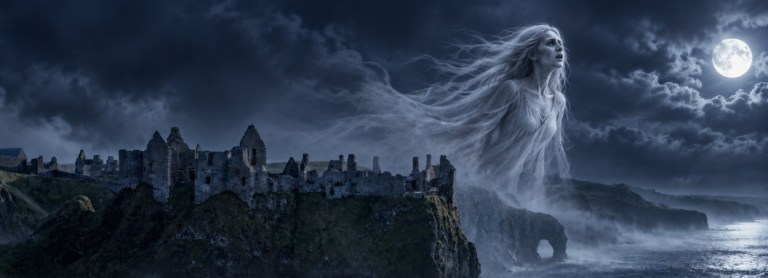
For generations, stories have clung to the dramatic ruins of Dunluce Castle, perched high above the Atlantic on the north Antrim coast. Among the best known is the tale of a mysterious banshee whose cries are said to echo around the cliffs when death or tragedy is near.
According to local folklore, the spirit is sometimes heard before she is seen. Her wail is described as long, mournful and almost human, carried on the wind above the sea and through the broken stone walls of the castle.
Some versions of the story describe her as a woman dressed in pale clothing, appearing near the ruins before vanishing without trace. Others say the sound alone is enough — a warning that something terrible is about to happen.
Like many old Irish banshee stories, the Dunluce legend has changed over time. Different families and local storytellers have passed on their own versions, adding details that blur the line between history, folklore and imagination.
What has remained constant is the setting: a ruined castle above a dangerous coastline, centuries of history beneath its walls, and a story that refuses to disappear.
Whether the banshee of Dunluce was born from an old tragedy, local superstition, or generations of storytelling, the legend has become part of the atmosphere surrounding one of Northern Ireland’s most striking historic sites.
History or Legend?
Dunluce Castle itself is very real, with a history stretching back centuries. The ruins that stand today are closely associated with the MacQuillan and MacDonnell families, and the castle’s dramatic position above the north Antrim coast has helped make it one of Northern Ireland’s most recognisable historic sites.
The banshee story, however, belongs to folklore rather than documented history. There is no firm historical evidence proving that a supernatural figure appeared at Dunluce or that her cries foretold particular deaths.
That does not make the legend unimportant. Banshee traditions are deeply rooted in Irish folklore, where the cry of a mysterious female spirit was traditionally regarded as a warning that death was approaching a family.
Over time, stories like these often became attached to castles, old houses and places associated with tragedy, conflict or powerful families. Dunluce, with its ruined walls, exposed cliffs and long history, provided the perfect setting for such a tale.
It is also possible that different stories became blended together over generations. Details may have changed as the legend was retold, making it difficult to trace a single original version.
So the banshee of Dunluce is best understood as a piece of local folklore connected to a genuine historic place. The castle is historical; the haunting remains legend.
That distinction is part of what makes the story so interesting — somewhere between recorded history and generations of storytelling, the banshee became part of Dunluce’s identity.
Location Image Placeholder
Map Placeholder — add an address or coordinates
References & Notes
Song Inspired by This Story
Song title
Listen to a preview of the original song inspired by this Northern Ireland legend.
Song preview to be added.
Quick Information
Northern Ireland After Dark
Ghosts, Legends & Folklore
Hear original songs inspired by Northern Ireland’s ghosts, legends and folklore on Northern Ireland Online Radio.
Radio Image Placeholder
Share This Story
Know a story like this?
We’re always looking for local legends, ghost stories and folklore from across Northern Ireland.
Related Ghost Stories
“Old stories never die. They just find new voices.”
The Legend
Write your folklore story here. Distinguish local tradition from documented history.
History or Legend?
Add the historical context and explain which parts are legend or uncertain.
Location
Add the location’s history, connection to the story and verified visitor information.
Location Image Placeholder
Map Placeholder — add an address or coordinates