
Home › Ghosts & Folklore
LEGEND
Oonagh of Dalway’s Bawn – The Haunting That Followed a Family
Ballycarry | County Antrim | Banshee / Poltergeist | Local Legend
On the countryside near Ballycarry stand the remains of Dalway’s Bawn, a reminder of County Antrim’s Plantation-era past. But alongside the history of the old fortified site survives a much darker story.
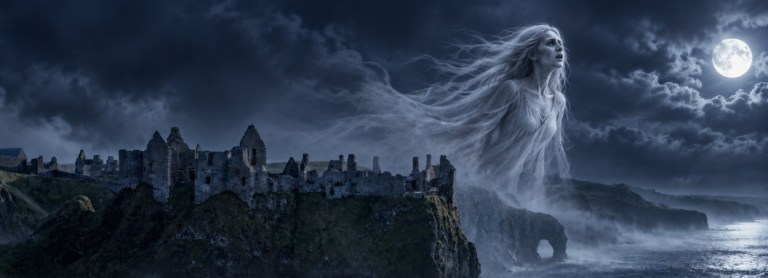
For generations, local folklore has associated the Dalway family with a mysterious female presence known as Oonagh.
The Legend
The story of Oonagh has survived in different forms, and—as with many old Northern Irish ghost stories—the details vary depending on the telling.
At its heart is the Dalway family and their old home at Dalway’s Bawn.
Oonagh is usually described as a supernatural female presence associated with the family. In some versions she takes on characteristics of the traditional Irish banshee, while other accounts describe disturbances much closer to what we would now call poltergeist activity.
Strange noises and unexplained incidents were reportedly experienced around the Dalway home.
As the disturbances intensified, living with Oonagh became increasingly difficult.
Eventually, according to the legend, the family decided to leave the old residence and move into another house.
Perhaps they believed distance would finally bring the haunting to an end.
It didn’t.
She Followed Them From Dalway’s Bawn
The most memorable part of the story is what supposedly happened after the Dalways moved.
The disturbances began again.
Whatever had troubled the family at their former home appeared to have travelled with them.
Oonagh, the legend says, had followed the Dalways.
The new house was reportedly subjected to increasingly violent unexplained activity. The haunting became associated not simply with a particular building, but with the family itself.
This is what makes the Dalway story unusual.
Many traditional ghost stories revolve around a spirit trapped in a particular castle, road, room or place. Oonagh apparently wasn’t confined to the ruins of Dalway’s Bawn.
Leaving wasn’t enough to escape her.
The House That Lost Its Upper Storey
One of the strangest elements of the legend concerns the family’s later house.
According to versions of the story, the disturbances became particularly troublesome around its upper portion.
Eventually, the problem was supposedly dealt with in an extraordinary fashion: the upper storey was removed.
It is a dramatic detail and one that has helped the story survive.
Afterwards, the disturbances were said to have diminished or stopped.
Whether the alteration really had anything to do with a supposed haunting is another matter entirely, but within the folklore it provides the story with its eerie conclusion.
The family had moved away from Dalway’s Bawn.
Oonagh had followed.
And only after part of their new home was taken away did silence finally return.
History or Legend?
There is an important distinction between the real history of Dalway’s Bawn and the supernatural story that later became associated with it.
Dalway’s Bawn is not an invented location. The site has genuine historical roots stretching back centuries, and its surviving remains provide physical evidence of the fortified buildings constructed during the Plantation period.
The haunting of Oonagh is much more difficult to establish historically.
Like many supernatural traditions, the story appears in different forms and accumulated details through retelling. Terms such as banshee, ghost and poltergeist can also be applied differently depending on which version is being told.
There is no evidence that can establish that a supernatural being followed the Dalway family from one house to another.
That does not make the folklore unimportant.
The story’s survival tells us something different: people continued telling it.
Somewhere between the ruins, the Dalway family history and generations of local storytelling, Oonagh became part of the folklore of this corner of County Antrim.
Dalway’s Bawn
Dalway’s Bawn is associated with the Plantation period in County Antrim.
A bawn was a fortified enclosure, generally constructed to protect a house, livestock and property. Stone walls and defensive features provided security during a period when settlement in Ulster could be dangerous.
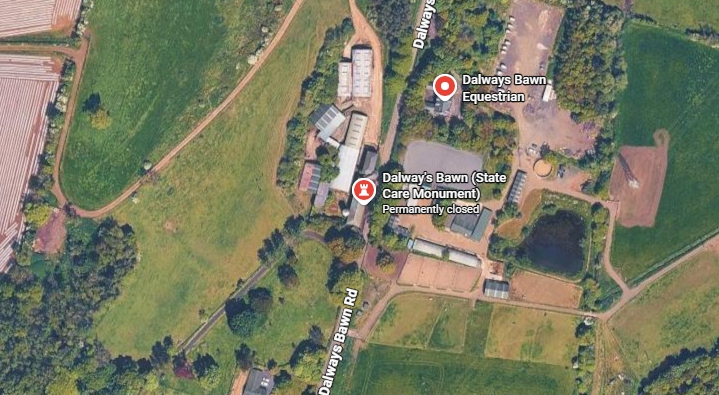
Surviving elements at Dalway’s Bawn include distinctive stone defensive structures that provide a tangible connection to this period.
Centuries later, however, the site is remembered for more than architecture.
Its ruined stonework became the backdrop to the tale of Oonagh—and to the unsettling idea that sometimes leaving a haunted house might not be enough.
Dalway’s Bawn, Ballycarry
Dalway’s Bawn is a well-preserved early 17th-century fortified enclosure, built around 1609 by John Dalway, then constable of Carrickfergus Castle. Today it forms part of a working farm, with the surviving roadside wall and three flanker towers visible from the road.
Song Inspired by This Story
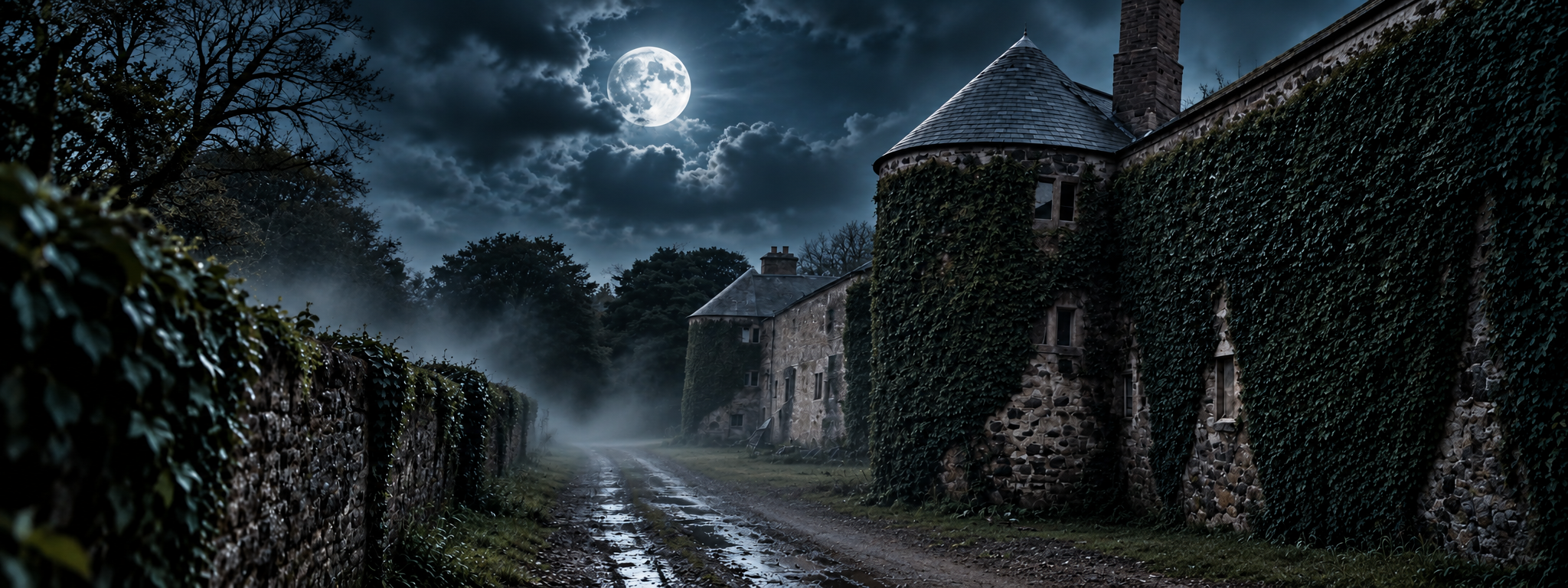
She Followed Us From Dalway’s Bawn
Listen to a preview of the original song inspired by this story.
Quick Information
- Location: Ballycarry area, County Antrim
- Folklore Type: Banshee / Poltergeist
- Associated With: Dalway’s Bawn and the Dalway family
- Period: early 17th century / c.1609
- Status: Local folklore associated with a genuine historic site
- County: County Antrim
Northern Ireland
After Dark
Ghosts, Legends & Folklore
Hear original songs inspired by Northern Ireland’s ghosts, legends and folklore on Northern Ireland Online Radio.
Share This Story
Know a story like this?
We’re always looking for local legends, ghost stories and folklore from across Northern Ireland.
Related Ghost Stories
“Old stories never die. They just find new voices.”