

New Assembly Rooms Interpretation Brings 250 Years of Belfast History to Life
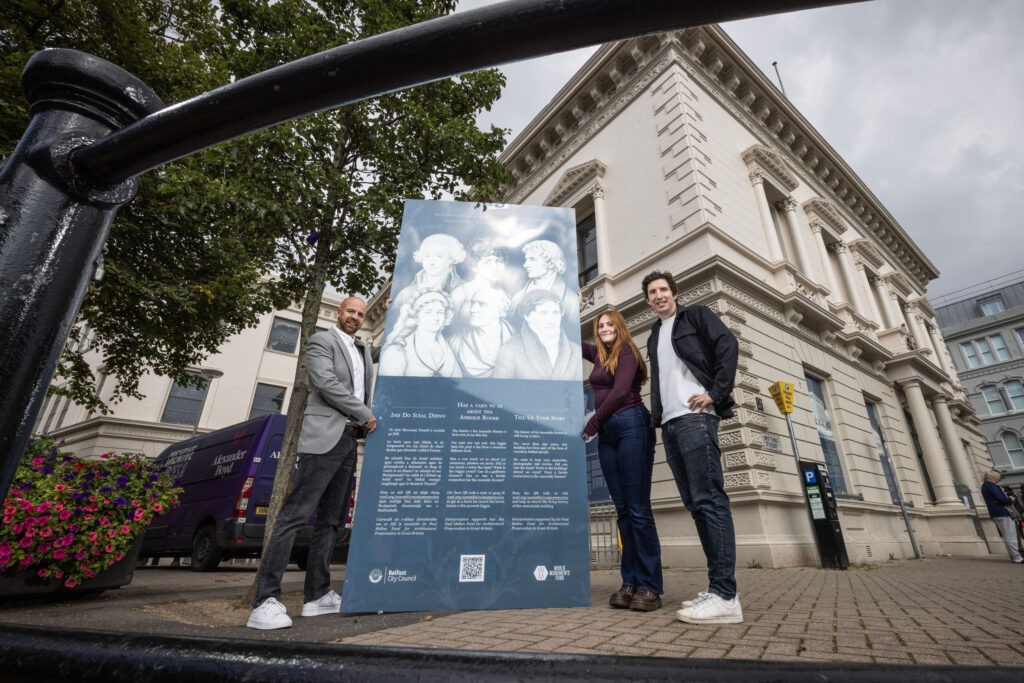
New interpretation panels have been installed outside Belfast’s historic Assembly Rooms, telling more than 250 years of the building’s history. The 29-panel scheme covers its role as an Exchange, social venue and bank, while the public is being asked to share photographs, stories and memories of the landmark.
New Assembly Rooms Belfast interpretation panels are helping residents and visitors discover more than 250 years of history connected to one of the city’s most important buildings.
The new exterior display follows ongoing conservation work involving Belfast City Council, the World Monuments Fund (WMF) and Belfast-based James Grieve Architects.
A total of 29 interpretation panels, presented in English, Irish and Ulster Scots, have now been installed around the historic building.
The panels explore the people, architecture and events that have shaped the Assembly Rooms since the 18th century.
More Than 250 Years of Assembly Rooms History
The Assembly Rooms stands at the corner of North Street and Waring Street and dates back to 1769.
Originally established as an Exchange, or market hall, the building later became the Assembly Rooms and developed into an important part of Georgian Belfast’s social life.
Its history includes several significant moments.
The building hosted the famous Belfast Harp Festival in 1792, while plans to establish a slave trading company in Belfast were rejected there in 1786.
United Irishman Henry Joy McCracken was also sentenced to death at the Assembly Rooms following the 1798 Rebellion.
It later became the headquarters of the Belfast Banking Company and continued its association with banking until the building closed in 2000.
Belfast City Council purchased the Assembly Rooms and neighbouring properties in October 2025 as part of its wider city centre regeneration plans.
Conservation Work Underway at Belfast Assembly Rooms
Earlier in 2026, Belfast City Council partnered with the World Monuments Fund on a conservation project designed to safeguard the Assembly Rooms for future generations.
James Grieve Architects has been involved in preparing a Conservation Management Plan for the building.
The plan will provide a framework for its future conservation, maintenance and sustainable use.
Research completed during that process helped inform the new interpretation scheme.
Councillor Joe Duffy, Chair of Belfast City Council’s City Growth and Regeneration Committee, welcomed the project.
He said:
“It’s fantastic to see the history of the Assembly Rooms being shared with Belfast residents and visitors alike through this interpretation project – and I’d encourage anyone with memories of this wonderful building to get in touch to share them.”
Councillor Duffy said the council wants to conserve and bring the building back into use while helping stimulate further regeneration in Belfast city centre.
Historic Belfast Figures Featured in New Panels
The interpretation also explores some of the important people associated with the Assembly Rooms.
Among them is Dr James McDonnell (1763–1845), sometimes described as the “Father of Belfast Medicine”.
McDonnell played an important role in Belfast’s medical, cultural and intellectual development and helped organise the Belfast Harp Festival of 1792.
The panels also feature Martha McTier (1742–1837).
McTier was influential in Belfast’s reforming culture and helped establish one of the city’s earliest maternity charities. She also contributed to the intellectual life of Enlightenment-era Belfast.
A collaboration with the Royal Society of Ulster Architects (RSUA) also examines three architects who helped shape the Assembly Rooms.
James Grieve said:
“The research has revealed just how many layers of Belfast’s history are contained within the Assembly Rooms.”
He said bringing the stories together would help people understand how the building has developed over more than two centuries.
‘Ghost Sign’ Discovered During Conservation Work
The remedial work on the exterior of the Assembly Rooms has also revealed previously overlooked details.
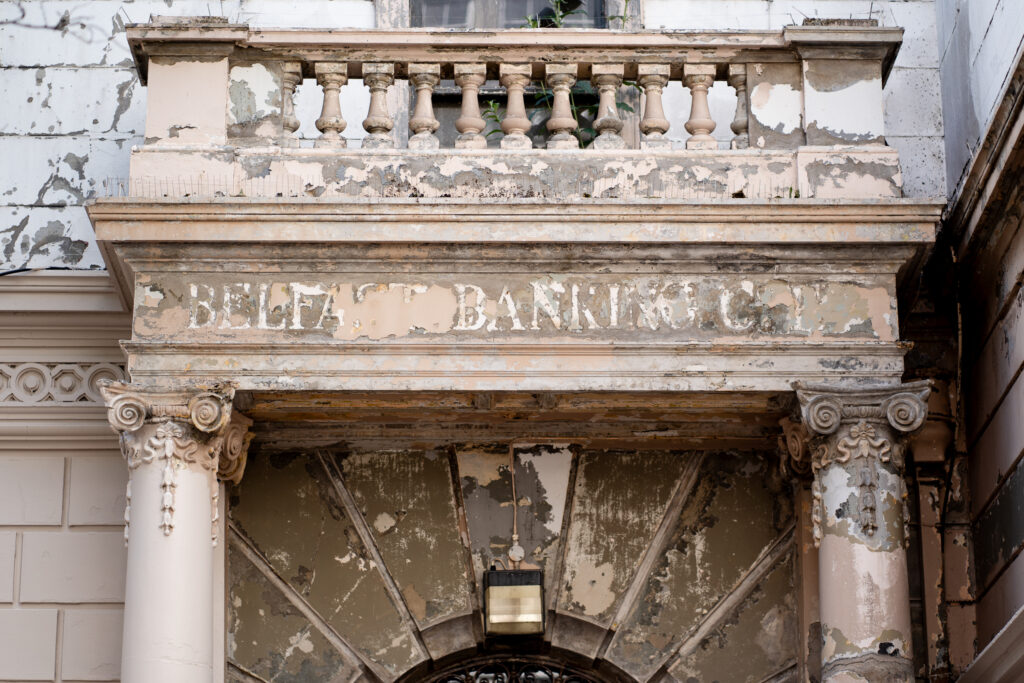
One is a historic “ghost sign”.
These fading, hand-painted advertising or business signs can survive on older buildings long after their original use has disappeared.
The new interpretation encourages people passing the Assembly Rooms to look upwards and spot the surviving feature.
Another element highlighted is the building’s former night safe.
The secure deposit facility allowed bank customers to leave cash and other valuables outside normal banking hours.
The use of night safes declined considerably as banking practices and technology changed.
Public Asked to Share Assembly Rooms Memories
The World Monuments Fund is now asking people who remember the Assembly Rooms to contribute to its continuing research.
Organisers particularly want to hear from anyone who:
- worked inside the building;
- visited when it operated as a bank;
- attended an event there;
- has historic photographs of the property;
- has family connections with the building; or
- remembers how the Assembly Rooms and surrounding streets once looked.
The memories and photographs will help document the building’s more recent social history.
This includes its long period of use as a bank, when visiting a local branch was a normal part of everyday life before online and mobile banking became widespread.
Share Your Assembly Rooms Memories
Anyone with photographs, stories or memories of Belfast’s Assembly Rooms can submit them through the World Monuments Fund’s Assembly Rooms memories project.
Assembly Rooms Forms Part of Wider Belfast Regeneration
The future of the Assembly Rooms forms part of wider regeneration activity taking place across this part of Belfast.
Nearby, Belfast Stories is planned for the former Bank of Ireland building and surrounding site at the top of Royal Avenue.
The major visitor attraction, public space and creative hub is currently intended to open in 2030.
Work is also underway at Cathedral Gardens, beside St Anne’s Cathedral and Ulster University.
Belfast City Council says the transformed public space is expected to reopen in spring 2027.
The council hopes bringing historic buildings such as the Assembly Rooms back into productive use will encourage further investment and regeneration across the northern part of Belfast city centre.
A New Chapter for One of Belfast’s Historic Buildings
After more than 250 years at the heart of Belfast, the Assembly Rooms is entering another chapter.
Its roles have changed considerably since the building opened in the 18th century.
It has served as a market exchange, meeting place, social venue and bank.
Now conservation work and historical research are helping ensure those different chapters are documented while decisions are made about the building’s long-term future.
Anyone with memories, photographs or stories connected to the Assembly Rooms is being encouraged to contribute and help preserve another part of Belfast’s social history.
Have photographs or memories of old Belfast? Share this article with someone who may remember the Assembly Rooms during its years as a bank.
Local guide
Explore more in Belfast
⌂
Belfast hub
N
Belfast news
E
Belfast events
B
Belfast businesses
F
Belfast fuel prices
T
Traffic & travel
⚽
Belfast Football
Explore Nearby Areas
More News
New Assembly Rooms Interpretation Brings 250 Years of Belfast History to Life
14 September 2026
No Comments
Read More »

Suspected Drink Driver Arrested After Van Leaves Road in Mid Ulster
13 September 2026
No Comments
Read More »

Where To Eat
- Food & Drink
- +1 Takeaway
Local guide
Explore more in Belfast
⌂
Belfast hub
N
Belfast news
E
Belfast events
B
Belfast businesses
F
Belfast fuel prices
T
Traffic & travel
⚽
Belfast Football
Explore Nearby Areas