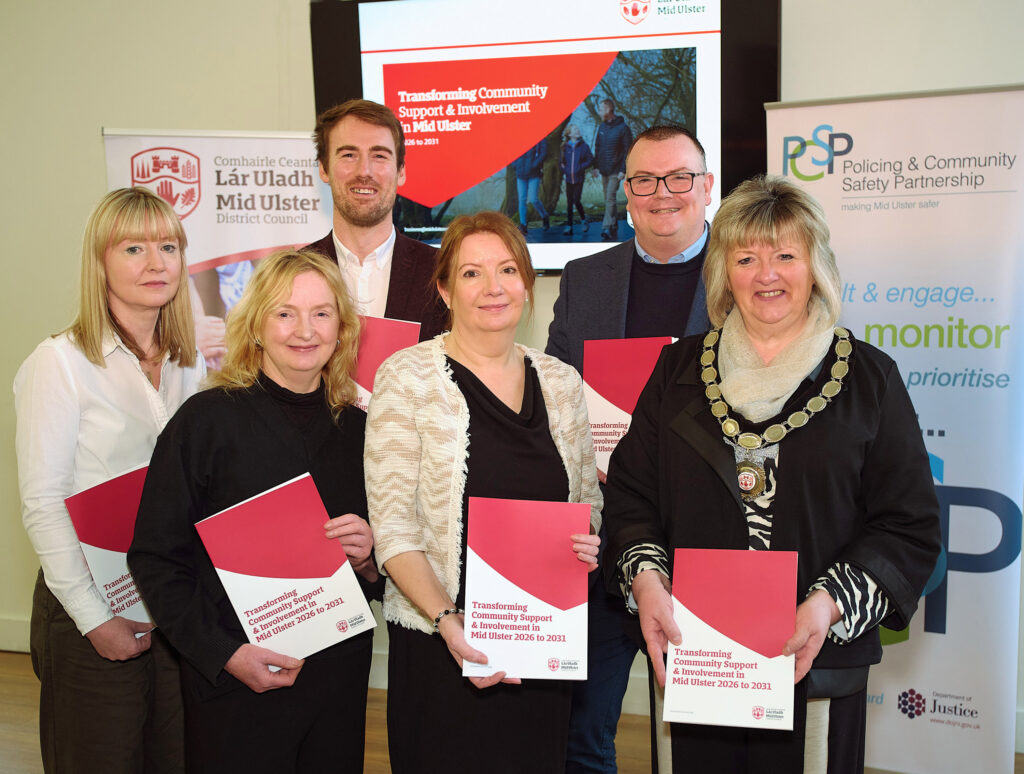
Mid Ulster District Council has launched its new Community Support and Involvement Strategy 2026–2031, introducing a unified “One Plan, One Budget, One Report” model to streamline funding, reduce duplication, and strengthen communities across the district.
Mid Ulster District Council has officially launched its new Community Support and Involvement Strategy 2026–2031, setting out a long-term framework to strengthen local communities, reduce disadvantage, and improve wellbeing across the district.
The strategy was launched on Wednesday 21 January at The Junction Dungannon, bringing together community representatives, partners, and stakeholders from across Mid Ulster.
A Unified Approach: “One Plan, One Budget, One Report”
At the heart of the strategy is a new outcomes-focused delivery model described as “One Plan, One Budget, One Report”. The approach is designed to bring together central and local government programmes under a single, coordinated framework.
Each year, more than £2.7 million is invested in community development across Mid Ulster through a combination of council and government funding. Until now, this funding has been delivered through multiple programmes operating independently, creating fragmentation and additional administrative pressures for community organisations.
The new strategy aims to:
- Reduce duplication across programmes
- Simplify reporting and monitoring requirements
- Ensure funding is targeted where it delivers the greatest impact
Six-Month Co-Design Process
The strategy has been shaped through an extensive six-month co-design process, involving:
- Local community groups
- Partner organisations
- Government departments
- Local residents
This engagement ensured the strategy is bottom-up and place-based, reflecting the real priorities and lived experiences of communities across Mid Ulster.
Three Core Strategic Goals
The Community Support and Involvement Strategy focuses on three long-term goals:
1. Reducing Poverty and Deprivation
Directing resources toward individuals and communities most affected by disadvantage.
2. Safety, Inclusion, and Respect
Promoting community cohesion, equality, and respect for diversity while supporting safer communities.
3. Stronger, More Resilient Communities
Building capacity through collaboration, shared ownership, and sustained community development.
System Reform and Delivery Priorities
To support these goals, the strategy identifies several key reforms, including:
- Integrating departmental policies within a single outcomes framework
- Introducing one shared reporting and monitoring system
- Pooling funding and resources to maximise impact
- Strengthening trust through co-design with communities
- Establishing partnership-based accountability structures
- Embedding equality, inclusion, and evidence-led practice
A central feature of the strategy is the alignment of existing programmes, including:
- Good Relations
- Policing and Community Safety
- Neighbourhood Renewal
- Community Support
These will now operate within one cohesive structure.
Partnerships and Local Networks
Delivery will continue to be supported by established local networks such as:
- CWSAN
- COSTA
- STEP
- Agewell
- The Volunteer Centre
- The Disability Forum
Regional partners including RCN, NICVA, and Volunteer Now will also play a key role.
Progress will be measured against shared wellbeing outcomes, including:
- Volunteering levels
- Life satisfaction
- Inclusion and safety
- Poverty and inequality reduction
These indicators will be benchmarked against Northern Ireland averages to assess impact.
Funding and Long-Term Planning
The Council will coordinate delivery through £2.71 million of pooled annual funding, locality-based approaches, and a move toward multi-year service agreements to support long-term planning and sustainability.
Co-design and evidence-led decision-making will remain central throughout implementation.
Council Response
Welcoming the launch, Frances Burton, Chair of the Council, said:
“This Strategy represents a significant and positive step forward for Mid Ulster. By bringing together programmes, partners, and communities under one unified approach, we are creating a fairer, more inclusive, and more resilient district for everyone.
Our communities are at the heart of this Strategy, and their insight has shaped its development from the very beginning. I am proud to endorse this collaborative vision and look forward to seeing its benefits realised across Mid Ulster in the years ahead.”
Further Information
More information on the Community Support and Involvement Strategy 2026–2031 is available by emailing:
communitydevelopment@midulstercouncil.org